The Salt of the Earth: How Sodium-Ion Breakthroughs are Reclaiming our Energy Future
For much of the twenty-first century, the dream of a green revolution has been haunted by a ghost of its own making: the supply chain. As we transitioned from fossil fuels to a world powered by electricity, we merely traded one form of extraction for another. The lithium and cobalt required to stabilize our batteries are locked in geological veins that require violent, ecologically taxing journeys through complex global politics. We sought to save the climate, yet we inadvertently built a new architecture of dependency—a “white gold” rush that mirrors the very extractive systems we aimed to replace.
But beneath this tension, something subtle and transformative is occurring in the laboratories where material science meets planetary necessity. The question being asked by researchers today is not just how much energy we can store, but *what* that storage is made of. As we look toward a truly regenerative future, the focus is shifting from rare, high-conflict elements to the most abundant substances on our planet: salt and sodium.
Recent advancements in sodium-ion technology are offering a glimpse of this new paradigm. While lithium-ion batteries have long been the gold standard for density and performance, their scarcity remains a bottleneck for true energy sovereignty. Sodium, by contrast, is ubiquitous. It sits in our oceans, in salt flats, and in common minerals. The challenge has always been finding a way to make sodium-based chemistries perform at scales that can support more than just small electronics.
A profound breakthrough has emerged from the University of Surrey, where researchers have discovered a way to optimize the performance of sodium vanadium oxide—a key material in next-generation batteries. In a remarkable turn for materials science, they found that by allowing the material to retain naturally occurring water within its structure, they could nearly double its power output. This isn’t just a technical optimization; it is a fundamental shift in how we perceive ‘impurities.’ What was once seen as a hindrance—the presence of water—has been harnessed to unlock energy capacity, bridging the gap between experimental promise and commercial viability for grid-scale storage.
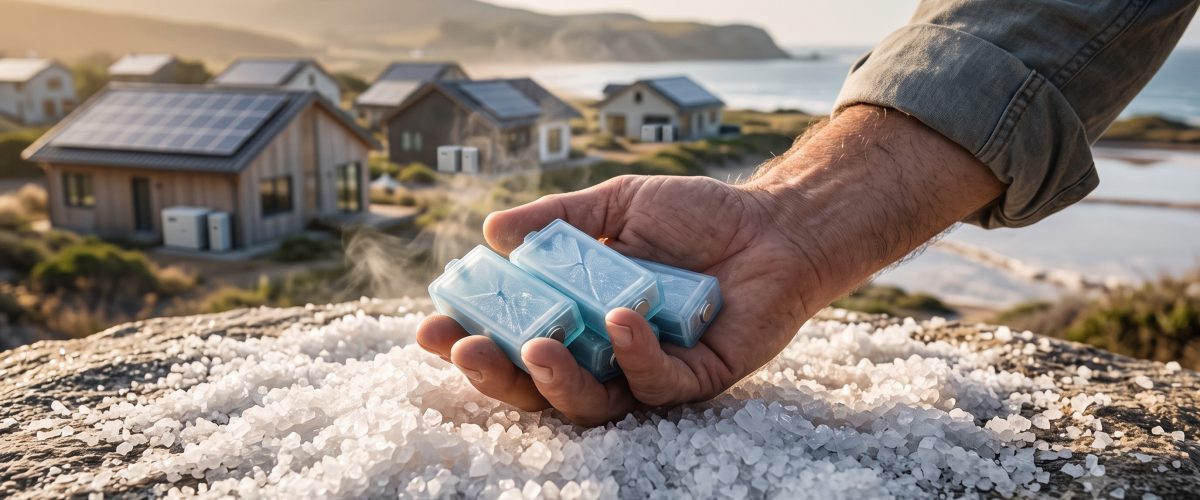
This breakthrough moves us closer to the concept of ‘everything-to-grid’ infrastructure. As we move toward a decentralized model where every building, vehicle, and community becomes a node in a massive, responsive energy web, we need buffers that are both affordable and ecologically benign. Sodium-ion batteries, with their potential for low cost and high sustainability, provide the perfect substrate for this transition. They offer the possibility of localized storage—batteries that can be manufactured near the communities they serve, using materials found in those very environments, breaking the cycles of dependency that define our current energy geopolitics.
This is the essence of sovereignty: the ability to power one’s own life through the resources of one’s own land, without disrupting the balance of the biosphere. When we transition from extractive minerals like lithium and cobalt to regenerative materials like sodium and iron, we are doing more than just switching chemistries; we are changing our relationship with the Earth. We are moving from a system that requires us to dig deep into its scars toward one that works within the rhythms of what is already available.
As these technologies move from the lab to the grid, we find ourselves standing at a threshold. The infrastructure of the future may not look like massive, centralized power plants and sprawling mining operations. It might instead look like silent, salt-based cells integrated into our homes, our walls, and our local grids—a quiet, ubiquitous pulse that stabilizes a world in transition.
As we master the chemistry of abundance, a question lingers: if energy becomes as common and accessible as the salt on our tables, what will it mean for the structures of power we have spent centuries building? Will a decentralized energy reality lead to an era of true human autonomy, or will we simply find new ways to own what was once free?
Sources
- University of Surrey research on sodium vanadium oxide and battery performance optimization.
- Research regarding the “everything-to-grid” concept as discussed by the World Economic Forum (WEF).
- Insights on green hydrogen catalysts and carbon conversion, cited via various chemical science publications (e.g., RSC/ACS).