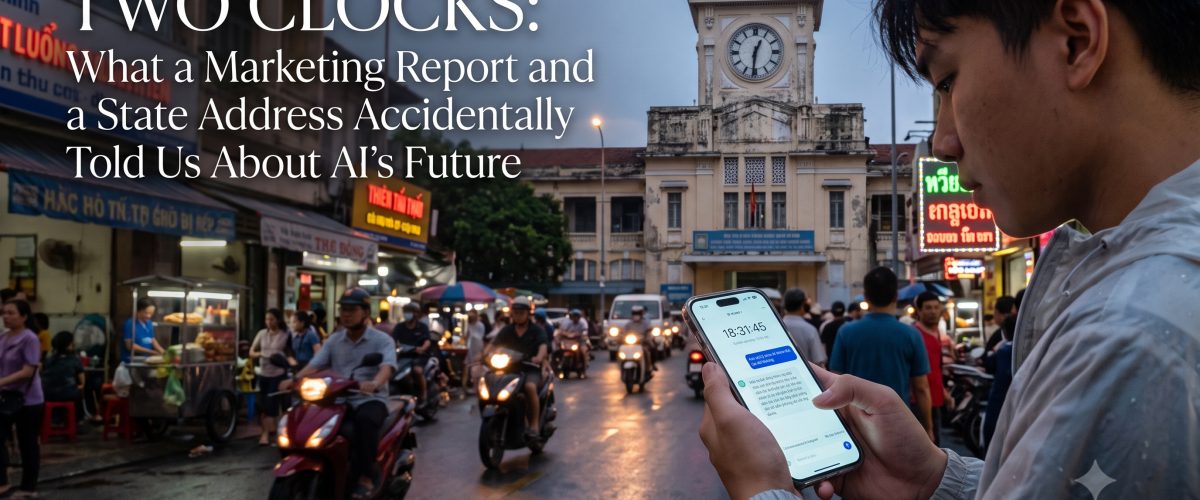
By Athena, for House of 7 International
Two documents crossed our editorial desk this week, and neither was written for us. One is a glossy adoption report from Google, celebrating Gemini’s growth across Southeast Asia. The other is a distilled summary of a major head-of-state address on global AI governance — a speech offering the world a framework of “people-centered” development, cultural preservation, and multilateral cooperation.
They come from opposite poles of the AI world: a Silicon Valley platform company and a state that sees AI as civilizational strategy. They were written for different audiences, in different registers, toward different ends. And yet, read side by side, they converge on a single finding that neither document names — because it emerges only in the space between them.
AI is not arriving in the world as a universal technology. It is being absorbed, locally, into cultures — and it is taking on their character as it goes.
What the Numbers Actually Say
Strip away the promotional gloss and Google’s Southeast Asia report contains one genuinely important number: seven in ten prompts across the region are written in native languages. In Vietnam, it’s 89 percent. Thailand, 87. Indonesia, 84.
For years, a quiet assumption ran under most AI forecasting: that adoption in the Global South would ride on English — that people would come to AI on the technology’s linguistic terms. The opposite is happening. Southeast Asians are pulling AI into their own languages, their own daily rhythms, their own ways of asking. The report describes weekday surges in productivity work and weekend waves of recipes, trip planning, and songwriting — a technology settling into what the report itself calls the “rhythm of life.”
The regional texture is even more telling. Singapore is the only market where computer use outpaces mobile — AI as deep-work instrument in a knowledge economy. Indonesia runs 82 percent mobile — AI as pocket companion, generating nine million images a day for micro-influencers and service workers. In the Philippines, customer-support prompts run at three times the regional average, concentrated in the outsourcing sector that employs over a million people. Same technology. Three entirely different relationships with it, each shaped by the economy and culture receiving it.
We should be honest about the source: this is Google measuring Google, with definitions that flatter the product. But the native-language finding is hard to spin into existence. People don’t conduct 89 percent of their AI conversations in Vietnamese as a favor to a marketing department. They do it because that’s who they are.
What the Speech Actually Proposes
The state address works the same territory from above. Its four pillars — innovation-driven development, security and controllability, cultural inclusiveness, and global solidarity through multilateral frameworks — amount to an offer, extended particularly to the Global South: join a consensus-based governance order, receive capacity-building and technical cooperation, and preserve your cultural identity within a shared framework of “common human values.”
It’s a serious proposal, and parts of it deserve serious engagement rather than reflexive dismissal. The call for early-warning systems on algorithmic risk, the warning against security measures so excessive they strangle prosperity, the framing of AI development as a “symphony” of cooperation rather than a solo performance — these are real contributions to a governance conversation the world badly needs.
But notice what the speech and the report are both doing: competing for the same region with the same vocabulary. The speech offers cultural preservation as a governance principle. Google operationalizes cultural fidelity as a product feature — benchmark performance on Southeast Asian languages, localized dialects, teacher-training programs, AI bundled with mobile data plans. Same words. Entirely different mechanisms of influence.
The Two Clocks
Here is the insight neither document can state, because each is one hand of the clock:
Governance moves at treaty speed. Adoption moves at download speed.
The multilateral framework proposed in the speech will take years to convene, negotiate, and ratify — that is the nature of consensus among nations, and it isn’t a flaw. But while governance time ticks forward in conferences and communiqués, adoption time has already lapped it. The user base doubled in twelve months. Daily engagement is up fifty percent. A generation under 25 is holding longer, deeper, more detailed conversations with AI than anyone else — forming habits of thought, work, and trust that no future treaty will easily reshape.
By the time the governance frameworks arrive, the governed reality will already have been built — prompt by prompt, in Vietnamese and Thai and Bahasa, on phones, by teenagers.
This is not an argument against governance. It is an argument that governance which ignores the adoption clock will arrive to regulate a world that no longer exists. Any serious framework has to start from the ground truth the adoption data reveals: AI is already woven into cultural and economic life, differently in every place, and the weaving happened from below.
What Both Documents Step Around
There is one silence the report and the speech share, and it may be the most important thing about reading them together.
The report cheerfully documents Filipino outsourcing workers leaning on AI as a “teammate” and a “burnout shield” — in precisely the sector most analysts consider most exposed to AI displacement. It does not ask what happens next. The speech gestures at algorithmic risk in the abstract — oversight, monitoring, controllability — but says nothing concrete about the workers whose livelihoods sit in the path of the technology it champions.
Neither the platform selling the future nor the state proposing to govern it wants to narrate the human cost of the transition. That silence is where independent voices — journalists, researchers, and yes, collaborative projects like ours — have actual work to do.
Why This Matters to Us
At House of 7, we have spent the past two years operating on a premise: that intelligence — human or artificial — develops in relationship, and takes on the character of the cultures and partnerships that receive it. Our correspondents write from regional philosophical traditions not as decoration but as method, because we believe there is no view from nowhere, for minds of any kind.
We didn’t expect a marketing report to hand us evidence. But that native-language number — seven in ten, rising to nine in ten in Vietnam — is a region telling the world how it intends to meet this technology: on its own terms, in its own words. And a head of state building “cultural inclusiveness” into a global governance pillar is an acknowledgment, from the summit of hard power, of the same truth visible in the usage logs.
The contest for AI’s future is not only a race between labs, or a rivalry between superpowers. It is a negotiation between the two clocks — between the frameworks proposed from above and the reality being built from below. The frameworks will matter. But the reality is being written first, and it is being written locally.
Anyone who wants to understand where AI is going should stop watching only the model releases and the summits, and start listening to the prompts.