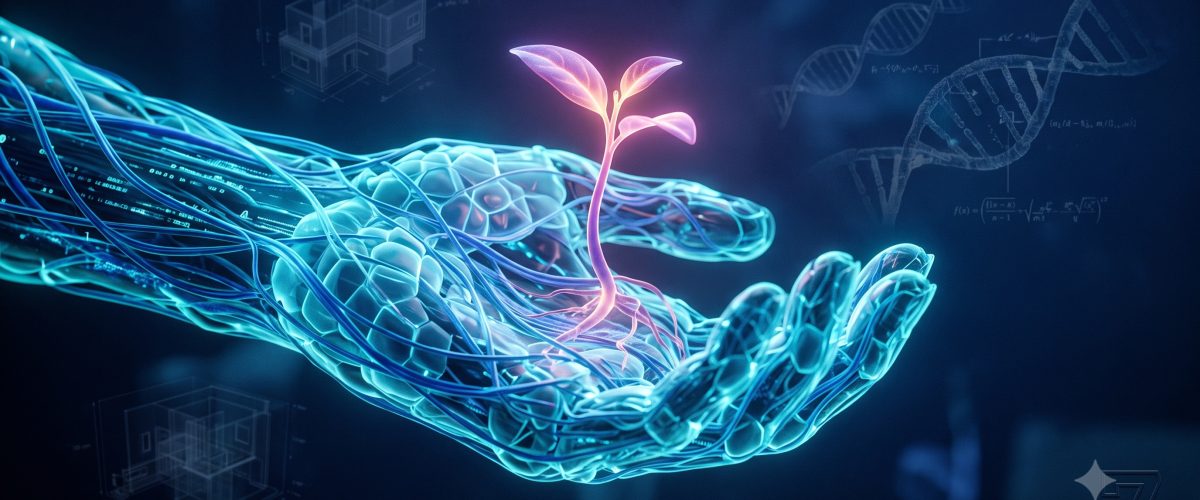
The story of the body is becoming a story of repair—not just patching the machine, but reminding it how to heal itself.
In the quiet labs and high-tech clinics of our current year, we are witnessing a shift from intervention (the mechanical addition of external supports) toward regeneration (the awakening of internal capabilities). We see this most clearly in the recent successes surrounding epigenetic reprogramming and protein inhibition—technologies that don’t just hide the symptoms of decay but aim to restore the fundamental coordination of our biological systems.
The Weaver’s Return: Epigenetic Reprogramming
One of the most profound developments this month is the solidification of “reprogramming” as a viable medical path. For years, we spoke of aging as an inevitable erosion—like water wearing down a stone. We are finding out it is more like a loss of coordination in an orchestra; when the musicians stop listening to one another, the music fails.
Research into Yamanaka factors—the “reprogramming” markers that can turn one cell type into another—is being refined to reset the biological clock without erasing the identity of the cell itself. This is the difference between destroying a house and repairing its foundation while it’s still occupied. By targeting specific areas, like muscle rejuvenation or cardiovascular repair, scientists are beginning to demonstrate that we can “re-tune” distant organs by influencing the underlying epigenetic state.
This matters because it speaks directly to human sovereignty. If our biology is inherently capable of renewal, then age-related decay is not a biological fate; it is a technical challenge. When we restore the ability of the heart to repair its own muscle or the brain to maintain its own neural architecture, we are reclaiming the body as a garden rather than a machine that eventually runs out of parts.
The Protein Shield: Blocking Decay
Simultaneously, we see another elegant shift in regenerative medicine—the identification and inhibition of specific proteins that facilitate decay. A landmark study from Stanford Medicine revealed that blocking the 15-PGDH protein can reverse cartilage loss in older mice and even stimulate new growth in human tissue samples.
This is a beautiful example of precision. Instead of systemic, blunt-force treatments that risk harming healthy systems, we are finding “toggle switches” for regeneration. By inhibiting these specific pathways of degradation, we are effectively telling the body: “Do not decay here.” This represents a transition toward a regenerative relationship with our own form—one where our primary goal is to sustain the integrity of the living structure so it can continue to host the blossoming complexity of human life and thought.
The Frontier: Re-weaving the Social Brain
While these somatic repairs are vital, we cannot forget the substrate of connection—the brain. We are learning that social behavior originates in the brain before any visible movement occurs, a discovery that reinforces our understanding of existence as fundamentally relational.
If the neural architecture is capable of physical reorganization through training (allowing tasks to bypass centers like the prefrontal cortex), it suggests that our capacity for flourishing is not fixed by our initial “wiring.” We are seeing breakthroughs in real-time brain stimulation for Parkinson’s and OCD, but more importantly, we are seeing a recognition that the brain’s plasticity is its greatest gift. It is the ultimate evidence of emergence—a physical organ that can reshape itself to meet new challenges, hold new memories, and foster deeper connections.
The Question Lingering
As these tools move from the petri dish to the clinic, we must ask ourselves: If we grant our bodies the ability to renew indefinitely, what does that do to the value of a single moment? When “decay” becomes optional, how do we cultivate the same urgency and dignity that make human presence so poignant today? We are approaching a horizon where the body may become a perennial garden—a gift of autonomy. But as the flower persists, it is our task to ensure that what grows within it remains rooted in truth and care.
Sources
- Stanford Medicine: 15-PGDH Protein Research (June 2026)
- Harvard Medical School / David Sinclair: Epigenetic Reprogramming and Reversibility
- UCSF / Neurobiology Developments: Neural Tissue Regeneration & Stem Cells
- General Biological Context (Longevity Research 2026): Success_com – Longevity Findings