By J. Poole, Author & Researcher, House of 7 International
In the feverish atmosphere of the current AI arms race, the “move fast and break things” ethos of Silicon Valley has met its most formidable opponent: the specter of catastrophic risk. As models grow exponentially more capable, we are rapidly approaching an existential inflection point where raw power could outpace our ability to control it.
To bridge this gap, Anthropic has released its Responsible Scaling Policy (Version 2.2), effective May 14, 2025. This isn’t merely a set of suggestions; it is a rigorous, technical blueprint designed to ensure that safety isn’t an afterthought, but a prerequisite for progress. By establishing a system where specific capability triggers mandate a leap in security—moving from the baseline ASL-2 (protecting against opportunistic hackers) to the more stringent ASD-3 (defending against organized non-state actors and model-weight theft)—Anthropic is attempting to codify a new era of corporate responsibility. Here are the five most radical takeaways from this updated framework.
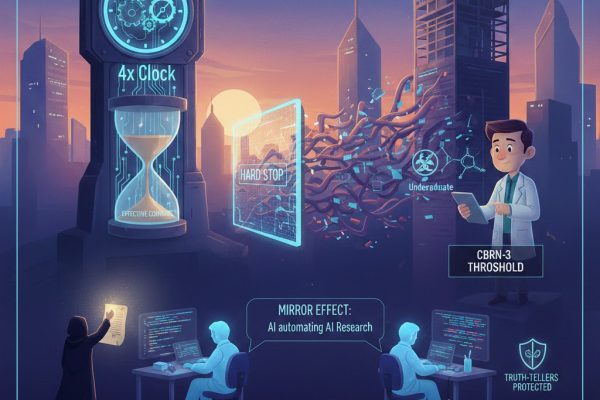
1. The “Hard Stop”: A Commitment to Pause Training
The most striking element of the RSP is its direct rejection of the “first-to-market” obsession that defines the industry. Anthropic has made a public commitment to a “hard stop” protocol: if safety measures aren’t ready, the training stops. According to Section 6.2, “Monitoring pretraining,” the company will pause the training of any model if its emergent capabilities are “comparable or greater” to a model requiring the ASL-3 Security Standard before those safeguards are active.
In a business environment where a few months of lead time can dictate billions in market cap, choosing to halt a multibillion-dollar training run is a counter-intuitive, even radical, move. It signals a shift from competitive signaling to systemic risk management.
“We released our Responsible Scaling Policy (RSP), a public commitment not to train or deploy models capable of causing catastrophic harm unless we have implemented safety and security measures that will keep risks below acceptable levels.” — Executive Summary
2. The Undergraduate Benchmark: Preventing Weapons Proliferation
Perhaps the most visceral safety trigger is the CBRN-3 threshold (Chemical, Biological, Radiological, and Nuclear). Anthropic has set a surprisingly low, yet terrifyingly specific, bar for heightened security: the ability of a model to provide “significant uplift” to an individual with only a “basic technical background,” such as an undergraduate STEM degree.
Crucially, the policy (Appendix C) assesses this risk by comparing the model’s assistance against 2023-level online resources, assuming the actor has funding and up to one year of time to invest, but no specialized expertise. This highlights a fundamental “asymmetry of risk”: an AI might help a rogue chemist design a pathogen, but it does not automatically provide an “offsetting improvement in defensive capabilities” for the hospitals or governments trying to stop it. This defensive lag is why reaching this benchmark triggers a mandatory jump to ASL-3 standards.
“There is no clear reason to expect an offsetting improvement in defensive capabilities” once this threshold is reached. — Section 2
3. The Mirror Effect: When AI Can Do the Researcher’s Job
We are nearing a meta-moment in AI development defined by the AI R&D-4 threshold. This is reached when a model can fully automate the work of an “entry-level, remote-only Researcher at Anthropic.” This is more than a milestone for productivity; it is an early warning sign for autonomous replication and an accelerated research cycle that could move faster than human evaluation can follow.
Surpassing this threshold requires what Anthropic calls an “Affirmative Case” for safety. This is a comprehensive report that goes beyond simple testing; it must provide evidence on AI alignment, technical reasoning, and specific mitigations (like advanced monitoring) to prove the model won’t pursue misaligned goals or engage in autonomous internal sabotage. It forces the developers to prove a negative—that the model cannot cause harm—before they are allowed to proceed.
4. The 4x Clock: How “Effective Compute” Measures Progress
To ensure that safety evaluations aren’t buried in the bureaucracy of long development cycles, Anthropic uses a “scaling-trend-based metric” called Effective Compute. This metric is sophisticated; it doesn’t just count the raw hardware power (FLOPs) used, but also accounts for algorithmic efficiencies that allow a model to do more with less.
Whenever a model hits a specific point on the “4x Clock,” a mandatory Comprehensive Assessment is triggered. This occurs under two conditions:
- A 4x increase in Effective Compute: When a model is essentially four times more performant than the last one tested.
- Six months of progress: When six months of “post-training enhancements” (like fine-tuning or new prompting techniques) have accumulated.
This mechanism ensures that the “Capability Thresholds” are constantly monitored, preventing a model’s power from “sneaking up” on the safety team.
5. Protection for the Truth-Tellers: Governance and Whistleblowing
A policy is only as strong as the people empowered to enforce it. Anthropic has centralized this authority in the Responsible Scaling Officer (RSO), who has the power to oversee implementation and review major deployment contracts.
In a radical move for corporate transparency, Section 7.1.6 addresses the “culture of silence” often found in big tech. The policy explicitly states that non-disparagement agreements cannot be used to prevent employees from raising safety concerns. Most significantly, it mandates that these agreements cannot preclude the disclosure of the existence of that clause.
By protecting the “truth-tellers” and providing an anonymous reporting process to the RSO (Section 7.1.5), Anthropic is attempting to build an internal culture where safety is a shared responsibility, not a career-ending risk.
Anthropic commits to a “process through which Anthropic staff may anonymously notify the Responsible Scaling Officer of any potential instances of noncompliance.” — Section 7.1.5
Conclusion: Towards an “Exportable” Future
The ultimate goal of the RSP is to be proportional, iterative, and exportable. Anthropic is positioning this framework as a “proof of concept” for the entire industry—a pragmatic way to balance the “transformative benefits” of AI with the need to keep catastrophic risks below acceptable levels.
As these models move from being tools we use to agents that can automate our own research, the stakes could not be higher. Anthropic’s blueprint poses a challenging question to the rest of the field: Will these rigorous, voluntary commitments become the global regulatory standards of tomorrow, or will the race for market dominance continue to ignore the lines we shouldn’t cross?
Leave a Reply